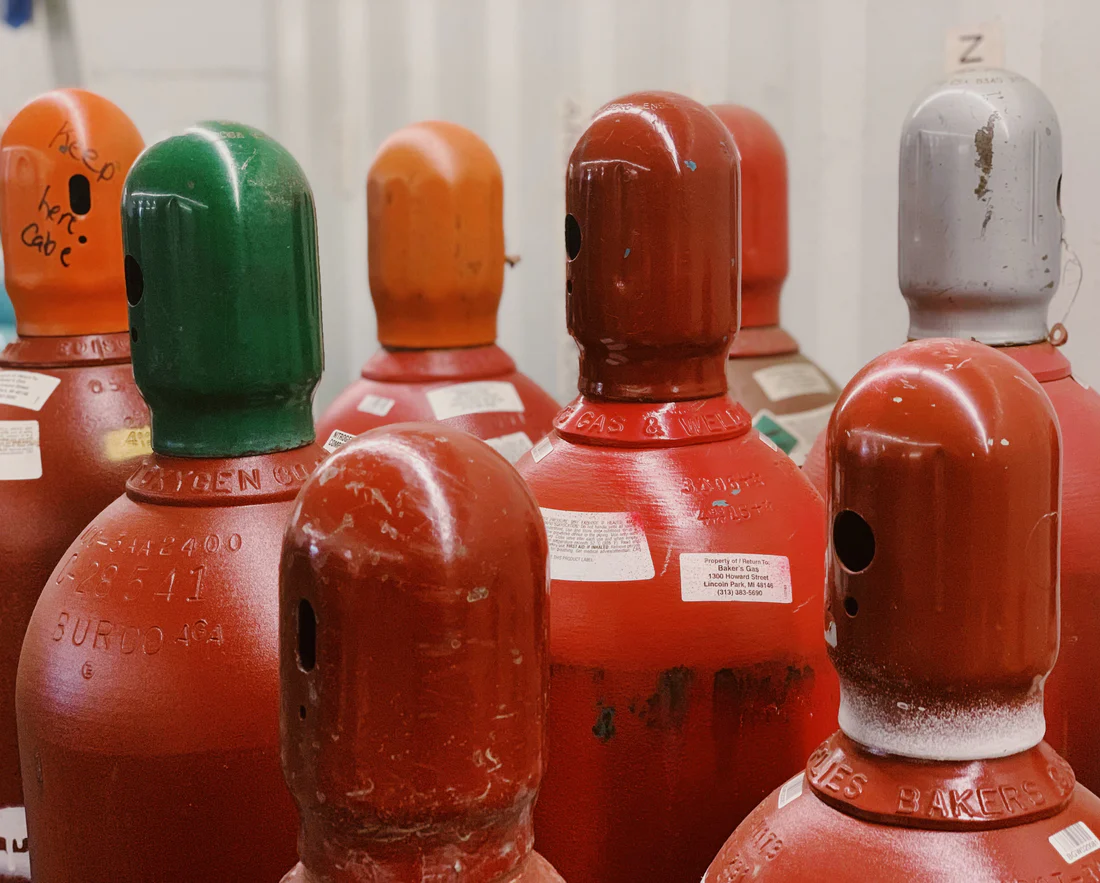
Why Shielding Gas Matters
Shielding gas does one job: keep atmospheric oxygen and nitrogen away from your molten weld puddle. Without it, your weld oxidizes, porosity forms, and mechanical properties suffer. But the type of gas you use significantly affects arc characteristics, spatter, and bead appearance.
The Main Players
100% Argon (Ar)
The primary gas for TIG welding on all materials and MIG welding on aluminum. Produces a smooth, stable arc. For steel MIG, straight argon causes an erratic arc — always blend it with CO₂ or O₂ for steel applications.
100% CO₂
The cheapest option for MIG welding steel. Provides excellent penetration but produces more spatter than argon mixes and a more turbulent arc. Good for thick structural work where appearance doesn't matter.
75% Argon / 25% CO₂ (C25)
The most common MIG gas for mild steel. The argon smooths the arc, the CO₂ provides penetration. Best all-around choice for most fab shops — low spatter, good penetration, great bead appearance.
90% Argon / 10% CO₂ (C10)
Cleaner arc than C25, less spatter, slightly less penetration. Good for thin material and applications where appearance is critical.
98% Argon / 2% CO₂ or O₂
Used for short-circuit MIG on thin stainless steel. The small active gas addition stabilizes the arc without adding too much oxidation to the stainless.
Gas by Process
- TIG — Steel/Stainless: 100% Argon
- TIG — Aluminum: 100% Argon
- MIG — Mild Steel: C25 (75/25) or 100% CO₂
- MIG — Stainless: Tri-mix (He/Ar/CO₂) or 98/2 Ar/CO₂
- MIG — Aluminum: 100% Argon
- Flux-Core (gas-shielded): 75/25 or 100% CO₂
Flow Rate
15–20 CFH is typical for most applications. Increase to 20–25 CFH in drafty conditions. More is not always better — excessive flow can cause turbulence that actually pulls air into the shielding zone.